Deutsche Bank’s latest metal flow report indicates that spot gold fund flows have reached an inflection point, with hedge funds, asset managers, and banks stepping in to buy, replacing the commercial and retail segments that had been consistently reducing their positions. At key price levels, $4,300 serves as the trigger for algorithmic selling, while $4,700 acts as the trigger for futures buying. More importantly, discretionary investors remain underweight in spot, futures, and ETF markets, suggesting that institutional positioning may only just be beginning.
Since late summer, commercial and retail investors have continued to reduce their positions, suppressing spot demand for gold. However, the latest report from Deutsche Bank indicates that this trend is shifting.
According to Zhuifeng Trading Desk, the bank released its latest "dbMetals All-Metals Flows Report" on September 3, setting the market tone with the headline "Here Comes the Cavalry." Daniel Ghali, Head of Metals Research, wrote in the report:
Capital flows into physical gold have reversed. While commercial and retail investors had been selling steadily during the late-summer rally, non-commercial participants are now taking the lead—spearheaded by discretionary hedge funds, asset managers, and banks. Their collective actions point to robust demand for physical gold at current price levels.
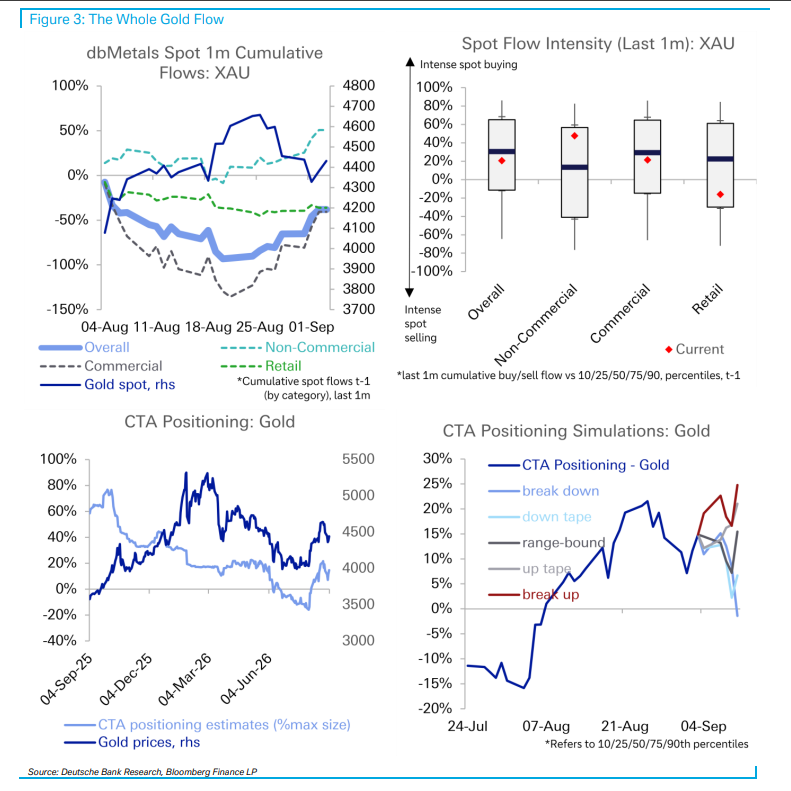
Deutsche Bank explicitly identified three key groups: discretionary hedge funds, asset managers, and banks are emerging as the primary buyers. Although buying interest has materialized, these buyers’ current positions remain relatively low. The report stated:
This aligns with our assessment that discretionary investors remain underweight in gold. Evidence from futures and forward curves suggests that the sharp rally in late summer was primarily driven by liquidity dynamics, while the dual financial suppression measures unexpectedly failed to attract significant inflows from discretionary capital.
Discretionary investors remain underallocated across spot, futures, and ETF channels. This may imply that the true institutional accumulation phase is only just beginning, leaving considerable upside potential yet to be realized.
CTA risks persist; monitor two key price levels closely
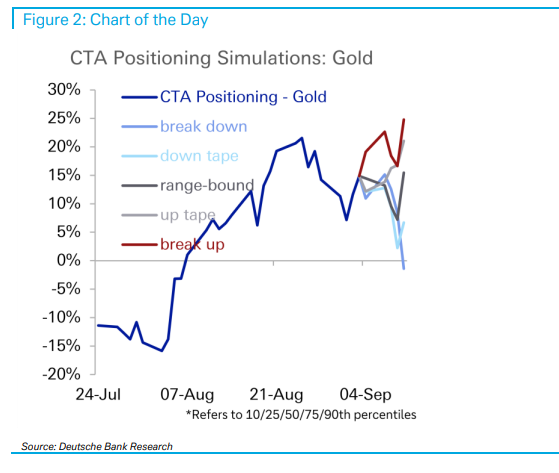
Deutsche Bank did not shy away from highlighting risks. Commodity Trading Advisors (CTAs)/trend-following algorithms are currently in a slight net-buying mode, and commercial selling pressure has eased. However, the report clearly warned:
A drop below $4,300 per ounce could trigger the next round of algorithmic selling, and if coupled with strong non-farm payroll data, there is room for further unwinding of positions.
A breakout above $4,700 per ounce would trigger subsequent inflows into futures, with total buying volume equivalent to +13% of the algorithms' maximum positioning.
Deutsche Bank summarizes the current situation in three points:
The cavalry has arrived.
Discretionary participants remain generally underweight in spot, futures, and ETF markets.
Once the $4,700 threshold is breached, algorithms will trigger follow-up buying.
Structural bull market: The Strait of Hormuz is more important than the Federal Reserve.
Looking beyond short-term tactical considerations, Deutsche Bank has provided a clear assessment of the long-term rationale for gold.
Analysts point out that the fundamental driver of gold's structural bull market is reserve diversification, a logic that has extended beyond interest rates and prices into the realm of geopolitics. He wrote:
In our worldview, conflict in the Strait of Hormuz currently plays a more critical role in the battle for reserves than Federal Reserve Chair Warsh's own fight against inflation—this directly impacts the foreign exchange reserve pools of major energy-importing and energy-exporting nations, which are likely to be active participants in the gold market.
Deutsche Bank also emphasizes that it is the multi-year bear market in government bonds, rather than the decline in risk assets, that is driving institutions and reserve managers to seek diversified assets.
Regarding energy prices, analysts believe:
Persistently rising energy prices pose a greater threat than a hawkish Federal Reserve. However, as long as energy prices do not break new highs, the current market stance remains bullish. While the market remains concerned about a hawkish Fed, the next surprise is likely to be strong performance in precious metals.
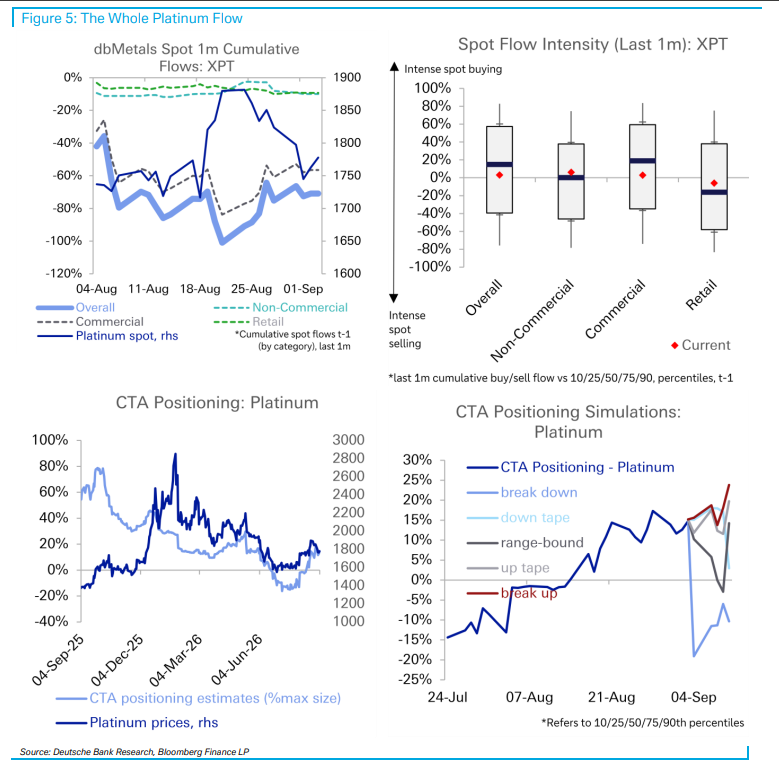
Other Metals: Platinum and palladium face algorithmic selling pressure; nickel experiences supply disruptions.
The report also covers capital flows in other metals, with key points as follows:
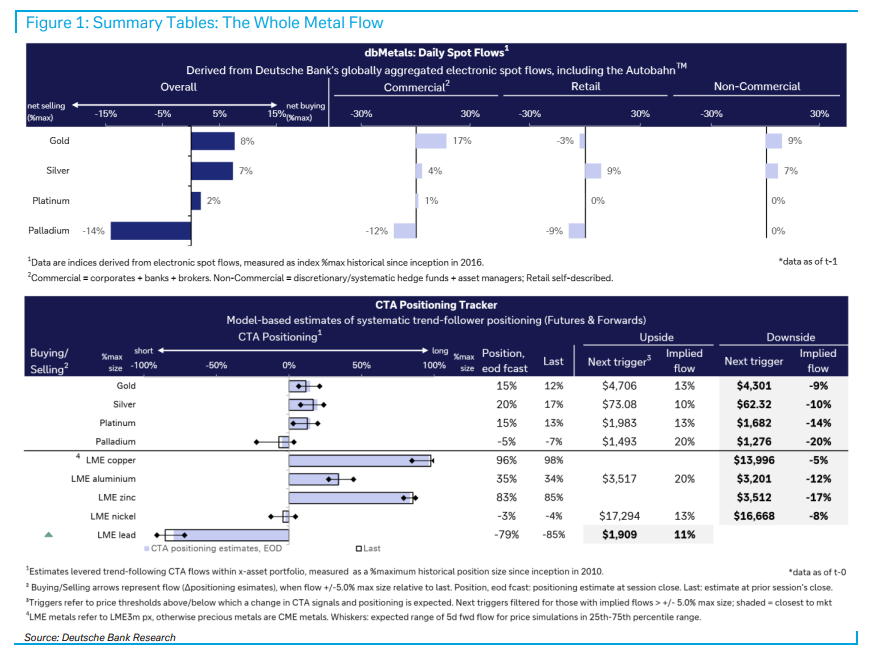
Platinum and Palladium: Algorithmic signals are heavily skewed toward selling. Deutsche Bank estimates that if prices decline, CTA selling programs for platinum could reach -12% to -26% of maximum algorithmic positions over the next week, while palladium could see -18% to -30%.
Aluminum: CTA signals are slightly biased toward buying, but asymmetry has largely dissipated, with direction trending neutral over the next week.
Nickel: Potential supply disruptions are emerging, though price reaction remains limited so far. Deutsche Bank notes that $17,300 per tonne for the LME three-month nickel contract is the next key level to trigger substantial CTA buying, with potential buying volume reaching +13% of maximum algorithmic positions. If risks of water-related disruptions caused by El Niño intensify, CTA buying could reach +30% in a breakout scenario.