Société Générale has clearly reasserted its bullish stance on gold, arguing that the hawkish shock has already been priced in and that downside risks are currently limited. Deutsche Bank confirms that a turning point for institutional capital has arrived, with hedge funds, asset managers, and banks taking over as buyers, though positioning remains low. Leading asset managers such as Amundi, Robeco, and Fidelity have increased their gold holdings during the pullback, while structural factors like central bank gold purchases and de-dollarization continue to provide support at the bottom of the price range.
The winds in the gold market are quietly shifting. After months of adjustment, the world's top investment banks and asset management firms are returning to the gold market with rare unanimity: Société Générale has turned bullish again, Deutsche Bank has confirmed an inflection point for institutional capital, and several major asset managers are also increasing their gold holdings.
In its latest market report, Société Générale expressed renewed optimism about gold, viewing it as an important hedge against currency and policy uncertainties; meanwhile, Deutsche Bank opened its report released on September 3 with the phrase "the cavalry has arrived," noting that discretionary hedge funds, asset management firms, and banks are taking turns buying spot gold, making them the market's new mainstay.
 Meanwhile, according to Bloomberg, several leading institutions—including Amundi, Pictet, Robeco, and Fidelity International—have increased their gold holdings during the recent price pullback. From investment banks turning bullish again to institutions actually adding to their positions, the gold market is witnessing an increasingly clear shift in capital flows.
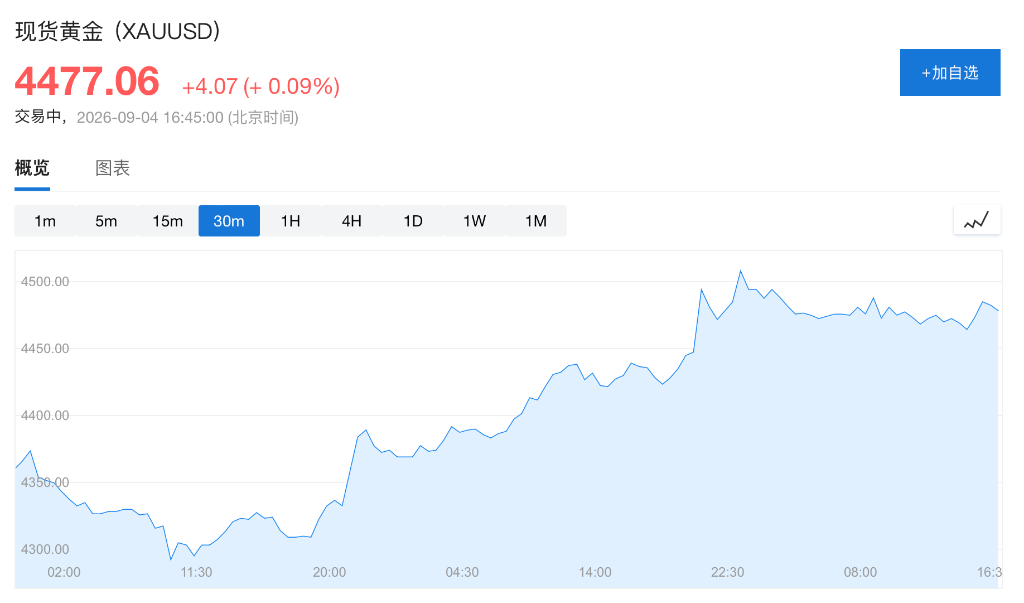
Gold prices are currently testing the $4,500-per-ounce level, still well below the recent peak of around $5,600. However, several institutions believe that this correction has actually improved gold's risk‑return profile. Although Federal Reserve Chair Jerome Powell reiterated his commitment to fighting inflation at the Jackson Hole symposium, adding short-term volatility to the metal, market consensus holds that the impact of hawkish expectations has largely been priced in, leaving limited room for a further sharp decline in gold prices.
Société Générale reiterates its bullish stance: hawkish pressure has been absorbed, and downside risks are limited.
In its latest report, Société Générale explicitly stated that, following a reduction in its gold holdings during the first half of the year, it now believes the time is ripe to re-enter the market.
Société Générale analysts note that gold initially plunged under the dual pressure of U.S.-Iran tensions and rising expectations for Federal Reserve rate hikes, but has since rebounded to around $4,500. Meanwhile, market volatility is returning to normal, speculative net long positions have climbed above their two-year average, and the GLD put-to-call ratio has fallen to a six-month low, signaling a shift in market sentiment back toward the bullish side.
"Since 2022, the market has undergone a clear structural shift," wrote analysts at Société Générale. Despite real yields remaining positive, gold has continued to trade near historic highs, diverging markedly from the price levels implied by conventional models. The bank believes that persistent central-bank gold purchases, de-dollarization, geopolitical uncertainty, and concerns about sovereign debt—among other structural factors—are underpinning a higher price floor for gold.
On the interest-rate trajectory, Société Générale's economists' baseline scenario assumes rates will remain unchanged through 2027, though they acknowledge that, should inflation persistently rise, the Fed could still deliver one additional hike this year. The bank argues that a meaningful shock to gold would require inflationary pressures far exceeding current levels, coupled with a more aggressive policy response from the Federal Reserve.
"At present, the hawkish shift has largely been priced into financial markets, and downside risks for gold appear increasingly limited."
Deutsche Bank: "The Cavalry Has Arrived"—A Turning Point for Institutional Capital Confirmed, Yet Positions Remain Low
In the "dbMetals Full Metal Flow Report" released on September 3, Daniel Ghali, Head of Metals Research at Deutsche Bank, opened with the phrase "the cavalry has arrived," confirming that a structural shift is underway in gold spot fund flows.
The report notes that the commercial and retail selling pressure that has weighed on spot demand since late summer is now waning, giving way to a relay of buying by discretionary hedge funds, asset managers, and banks. However, Deutsche Bank also emphasizes that, despite the emergence of buying interest, these institutional investors' positions remain markedly underweight across the board—whether in the spot market, futures, or ETFs.
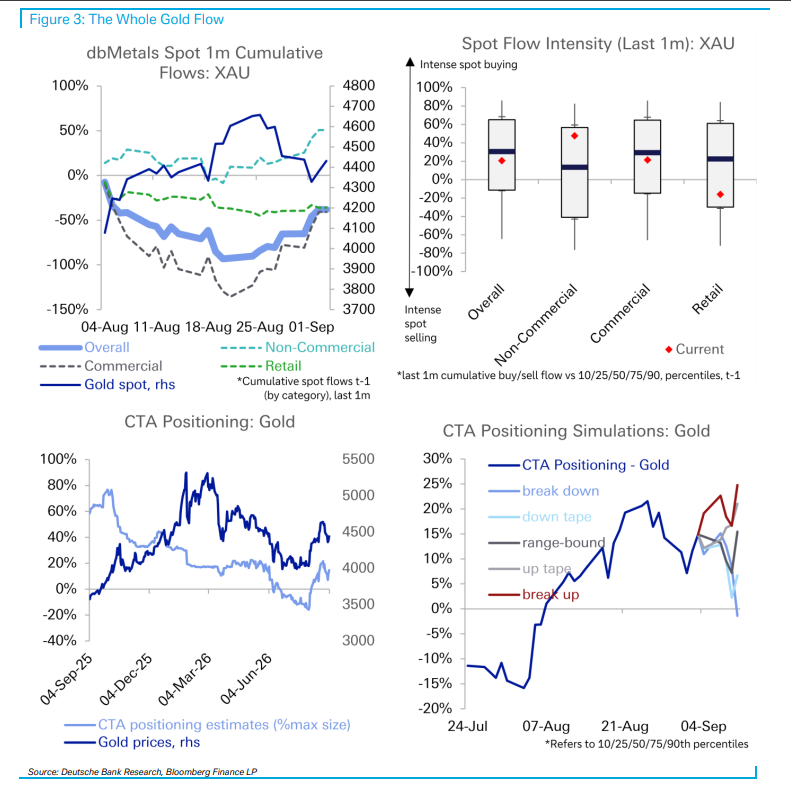
In a report dated September 1, Deutsche Bank outlined the evolution of this shift: over the past month, the gold spot market witnessed large-scale selling, with selling intensity reaching the 86th percentile of the past five years—primarily driven by commercial and retail investors. Meanwhile, CTA (commodity trading advisor/trend‑following algorithm) funds engaged in aggressive buying, at one point pushing their net long positions to 33% of their historical peak. However, quantitative indicators measuring the participation of active discretionary capital remained virtually unchanged throughout the late-summer rally and have since retraced 60% from their August highs.
"This is consistent with our view: discretionary investors remain underweight in gold," the Deutsche Bank report stated. This suggests that the genuine institutional positioning phase may have only just begun, and the upside potential has yet to be fully realized.
Asset management giants are stepping up their positions, signaling that gold's investment appeal is making a comeback.
According to Bloomberg, several leading asset management firms have recently increased their gold holdings and may continue to maintain bullish positions.
Amundi, Europe's largest asset manager, has been buying gold during the recent pullback and expects prices to rebound to $5,000 per ounce within the year. Lorenzo Portelli, Head of Cross‑Asset Strategy at the Amundi Investment Institute, notes that gold is "an asset perceived as undervalued, with strong hedging characteristics and reasonable liquidity," but adds that further position increases will have to wait until the Federal Reserve's interest-rate trajectory becomes clearer.
Robeco portfolio manager Arnout van Rijn views the central banks' accelerated gold purchases as a catalyst for re‑entry into the market. According to data from the World Gold Council, official sector net gold buying reached 289 tonnes in the second quarter of this year, marking the highest level on record for that period. "Gold has become a more widely accepted asset," he said, "and an indispensable component of every conventional investment portfolio."
Sophie Huynh of BNP Paribas Asset Management notes the declining correlation between gold and risk assets, suggesting that, after a round of speculation‑driven trading, gold's traditional hedging role is making a comeback. "The gold bubble has subsided," she says. "Today, gold prices are being driven by fundamental forces—central bank gold purchases and multi‑asset managers seeking portfolio hedging."
Recently, Ray Dalio, founder of Bridgewater Associates, issued an even stronger warning, advising investors to reduce their bond holdings and allocate up to 15% of their portfolios to gold as a hedge against U.S. debt risks.
$4,300 and $4,700: Key Thresholds for Gold Bullish and Bearish Capital
Despite the overall shift toward a more bullish outlook, underlying risks remain, with key technical levels warranting particular attention.
In its report, Deutsche Bank quantified the trigger thresholds for algorithmic trading: if gold prices fall below $4,300 per ounce, it could spark the next round of CTA‑driven programmatic selling; coupled with strong nonfarm payrolls data, downward pressure on positions could intensify. Conversely, if gold breaks above $4,700 per ounce, it may prompt follow‑on futures‑fund buying, at a scale equivalent to 13% of the algorithm's maximum position size.
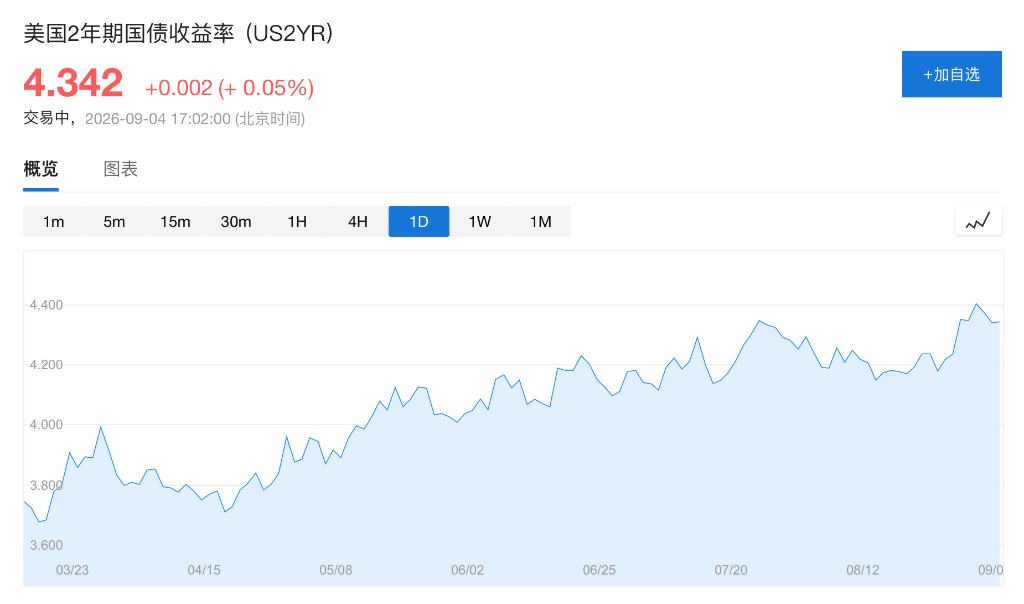
Société Générale also acknowledged that the current asymmetric pressures in international financial markets cannot be ignored: the yield on the two-year U.S. Treasury note has climbed back above 4%, bolstering the dollar, while Federal Reserve Chair Jerome Powell's remarks at Jackson Hole have further reinforced market expectations of another rate hike this year. According to Bloomberg, several asset managers surveyed also conceded that gold's move above the roughly $4,600 resistance level will not be smooth sailing.
However, Deutsche Bank offers a more nuanced assessment at the structural level: it is the prolonged bear market in government bonds—rather than declines in risk assets themselves—that has been driving institutions and reserve managers to pursue diversified allocations.